Solo educator
Turn one practical lesson into a question, three illustrated points and a recap.
The recurring outline makes a series easier to plan while leaving room to correct facts and vary examples.
faceless reels aiFormat first
Faceless reels templates give you a starting structure instead of an empty prompt. Pick a hook, a sequence of scenes and a closing line, then replace the topic-specific details before making your video.
A template-led start supplies a structure to fill in; a general prompt asks you to invent the structure as well as the subject.
Start with a list, a short explanation or a visual story. For faceless reels, the format determines how many ideas the viewer must follow and where each scene belongs.
Write a specific first line, one point per scene and a closing takeaway. Keep any on-screen text short enough to read at the pace of the video.
Read the captions in order without the visuals. If the story no longer makes sense, revise the transitions before you assemble or publish the reel.
It preserves a reusable scene order, identifies which details to swap and gives your next draft the same pacing to test. These related paths help when your task goes beyond that structure.
Choose a card by the kind of information you need to convey, not by a visual style alone. Each format still needs original wording and suitable footage.
Turn one practical lesson into a question, three illustrated points and a recap.
The recurring outline makes a series easier to plan while leaving room to correct facts and vary examples.
faceless reels aiMap ingredients, preparation and the final result to separate scenes before writing captions.
Viewers can follow the order even when the cook never appears on camera.
faceless reels generatorUse a location, a useful detail and a final planning tip as a repeatable sequence.
Each destination gets its own research and imagery without requiring a new structure every time.
faceless video aiOpen with a common problem, show one technique in action and end with a concrete next step.
A consistent pattern lets the creator focus on clear demonstrations rather than starting from a blank page.
faceless reels aiA template can make the intended sequence clearer. It cannot verify a claim, supply rights-cleared footage or guarantee that a topic will hold attention.
 Open-ended concept
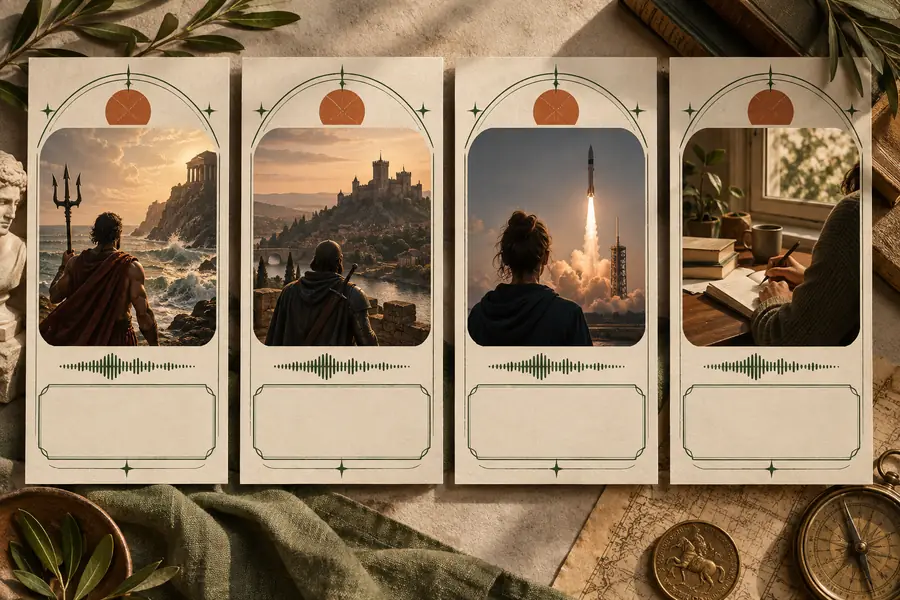 Template-led concept
Use this table to decide whether the structure is doing useful work. A template is a planning aid, not a substitute for editing decisions.
Starting point
Template-led start
A chosen hook, scene order and ending
General prompt
A topic or instruction with no fixed sequence
Best suited to
Template-led start
A recurring series with a recognizable rhythm
General prompt
A one-off idea that needs room to develop
What you customize
Template-led start
Examples, visuals, captions and timing within a format
General prompt
The format itself as well as every scene
Main risk
Template-led start
Repetitive openings or awkwardly forced scenes
General prompt
An unfocused sequence or missing conclusion
Fact checking
Template-led start
Still required for every claim
General prompt
Still required for every claim
Visual permissions
Template-led start
You must check rights to footage, images and audio
General prompt
You must check rights to footage, images and audio
Final edit
Template-led start
Adjust pacing when the topic needs more or less space
General prompt
Build and refine the pacing from scratch
Use a familiar hook-to-takeaway pattern to plan your next set of faceless reels. Change the substance for each topic, check every factual claim and review the captions against the finished scenes.
Plan a reelA useful template sets out the opening hook, the purpose of each scene and a closing takeaway. It may suggest caption length or visual types, but you should replace generic examples with details that fit your topic.
Yes, especially for a series with a consistent purpose. Vary the opening, examples and footage so the structure stays helpful without making every video feel identical.
No. A template is a plan for the sequence; you still need to prepare visuals, check any claims, edit the timing and review the finished result.
Pick the simplest format that fits the information you have, such as one question followed by three short points and a recap. If a scene requires material you cannot show or explain clearly, choose a different structure.
Not automatically. Check each platform's current format requirements and preview the video there, paying particular attention to caption placement, sound and the pace of the opening.