Facelessreels

Format decision

faceless reels vs youtube: Where Should Your Idea Go?

The useful faceless reels vs youtube question is not which platform wins overall. It is whether your idea needs a quick, self-contained payoff or enough room to explain, demonstrate, and hold attention over time.

three real scenarios, one pick each

Start with the viewer’s job, not the format you already know how to edit.

  1. 1

    A single visual tip: pick a reel

    Suppose you can show a desk-organization trick with three close-up shots and one line of narration. A short reel lets viewers understand the result before they need background. Keep the opening frame specific, put the action on screen, and end when the tip is complete. Stretching this into a longer YouTube video would require useful additional steps, not just slower cuts.

  2. 2

    A researched explanation: pick YouTube

    Suppose you are explaining how a historical event unfolded, with sources, a timeline, and competing interpretations. A longer YouTube video gives each claim room for context and lets viewers follow the argument. Faceless narration can work here, but images should clarify the story rather than fill silence. A short excerpt may later introduce the topic without pretending to replace the full explanation.

  3. 3

    A repeatable demonstration: pick the complete tutorial first

    Suppose you teach a spreadsheet workflow that has setup, execution, and a common error to fix. Record the complete demonstration so the instructions remain usable. Then cut one self-contained moment into a short reel that points interested viewers toward the fuller lesson. This order protects accuracy: you decide what can stand alone after you know what the complete task requires.

The solo educator

You have one surprising fact and a clear visual that proves it, but no larger lesson ready to publish.

Make a concise reel with a source check and readable captions; do not add filler merely to reach a longer runtime.

faceless reels examples

The software instructor

Your audience needs to see where a setting is, why it matters, and how to recover from a mistake.

Choose a complete YouTube walkthrough, then extract one independently useful tip for short-form viewing.

faceless youtube shorts generator

The anonymous storyteller

Your story has a setup, a turn, and a conclusion that make little sense when separated.

Give the full narrative room to breathe; use short clips only when a scene can make sense without misleading context.

faceless youtube channel ideas

The cautious first-time creator

You want to test a topic without committing to a long script or an ongoing publishing schedule.

Try a short, complete idea and review what viewers ask before planning a deeper video.

faceless reels ideas

capability matrix

The visual difference is often not subject matter, but how much context a viewer needs before the payoff.

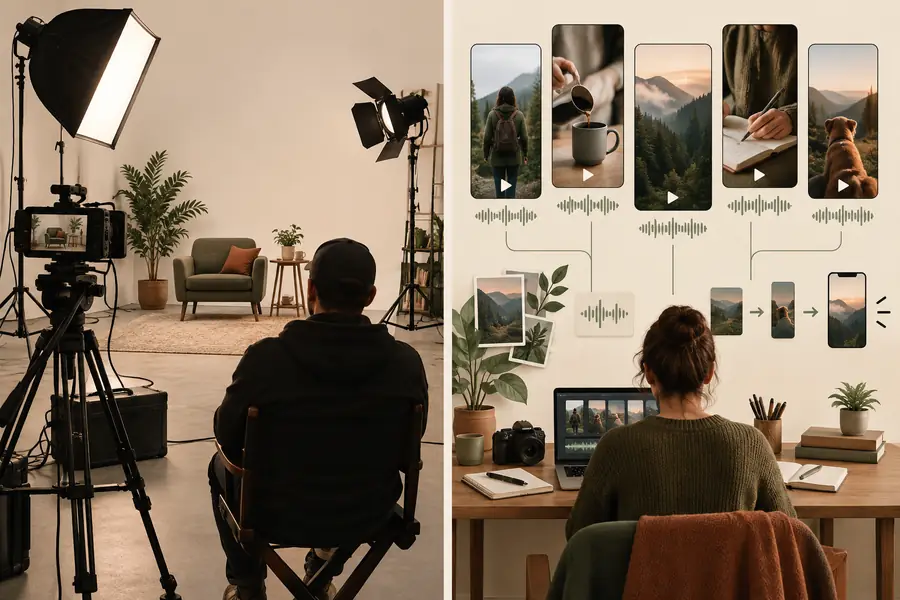
Illustration representing a brief, self-contained faceless video idea One clear moment
Illustration representing a faceless video planned for a YouTube audience A developed explanation
Treat these images as planning illustrations, not a performance test. For faceless reels, the first frames must establish what the viewer will get; a developed YouTube explanation can introduce a question and resolve it through evidence or demonstration. Either format fails when visuals merely repeat the narration.

shared pitfalls

Different runtimes do not excuse the same underlying problems. Use this checklist before choosing where to publish.

Short faceless reel
Longer YouTube video

Weak opening

Short faceless reel

A vague first frame makes the single payoff hard to identify.

Longer YouTube video

A long introduction delays the question or demonstration viewers came for.

Unclear source

Short faceless reel

A compressed claim can lose the qualification that makes it accurate.

Longer YouTube video

More runtime creates more claims to verify and attribute.

Generic visuals

Short faceless reel

Unrelated footage competes with captions in a small viewing window.

Longer YouTube video

Repeated filler footage makes a detailed explanation harder to follow.

Unreadable text

Short faceless reel

Fast cuts leave too little time to read an important step.

Longer YouTube video

Dense on-screen notes can distract from the spoken explanation.

Voice and sound

Short faceless reel

A rushed voiceover can obscure the only instruction that matters.

Longer YouTube video

Inconsistent levels become tiring across a longer session.

Rights and reuse

Short faceless reel

A short excerpt still needs permission or an applicable right to use it.

Longer YouTube video

A longer edit may contain more images, music, or clips that need checking.

Ending

Short faceless reel

A loop should not conceal that the promised answer never arrived.

Longer YouTube video

A recap should resolve the question rather than repeat the introduction.

our tradeoff

Make the idea clear before making it longer

Facelessreels is a starting point for shaping a faceless video idea, not a promise that one format will outperform another. Draft a short, complete scene when the takeaway fits on its own. If the viewer needs setup, evidence, or a sequence of actions, plan the fuller explanation instead. Review every factual claim, visual, caption, and usage right before publishing.

Try video creation
  • Choose the viewer’s takeaway first
  • Give necessary context enough room
  • Check the finished edit before publishing

comparison FAQ

Neither is better for every idea. A reel suits a takeaway that can be understood quickly without losing essential context; a longer YouTube video suits a process, explanation, or story that needs development. Judge the format by what the viewer must understand at the end, not by a hoped-for view count.

You can adapt an idea for both, but check the destination’s current format requirements and review the actual export before posting. Captions, framing, pacing, and the opening may need changes. Do not cut away a qualification or key step just to make a shorter version.

A short faceless clip can introduce a channel topic or deliver a complete tip. It does not have to be a teaser, and a teaser should not promise an answer it never gives. If you also make longer videos, use the short format for moments that remain understandable on their own.

A short reel usually has less material to script and edit, but clear captions, accurate claims, and well-matched visuals still take work. A longer video needs more structure and review, especially when it includes sources or multiple steps. Compare the work needed to explain your particular idea properly, rather than assuming short always means easy.

Start with a reel if you can deliver one useful result without missing context. Start with a full video if viewers need a sequence, evidence, or troubleshooting to act on the information. When both make sense, complete the explanation first and adapt a self-contained part afterward.

Start creating
Start creating